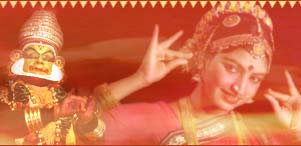
Originated in Kerala, Kathakali is essentially a musical dance drama, best known for its elaborate costumes, glaring make up, detailed gestures and well-defined body. The makeup and costumes form an essential part of the art. The literal meaning of this word means "story - play". The dancers perform and act out scenes from epics like Mahabharata, Ramayana and also the ancient Indian scriptures. The themes of Kathakali are usually religious in nature and the text is a mixture of Sanskrit and Malayalam. Kathakali was performed only by men earlier. In case, the script required female characters, their roles were also performed by men dressed in the female attires. However, since 1970, women started entering into the profession of being a Kathakali dancer. Now there are even all women Kathakali dance troupes in Kerala. A Kathakali performance is a major social event if organized in a community attended by all. Read on to know about the classical dance form: Kathakali.
History and Evolution of Kathakali
The tradition of Kathakali dates back to the 17th century. Kathakali was created from its originator, a dance-drama form called Ramanattam. Furthermore, it owes its technique to Krishnanattam. The word "attam" means enactment. Thus Ramanattam and Krishnattam together gave birth to Kathakali. As the name suggests, the dance drama was performed on stories or episodes of Hindu Gods, Rama and Krishna. The refined and present form we see today was prepared by Mahakavi Vallathol Narayan Menon, founder of Kerala Kala Mandalam. The dance form requires the performers to rely heavily on hand gestures and facial expressions to portray their character and replace the dialogues and messages with it. The hand gestures are an essential part of almost all classical dances and are known as "Mudra". Along with this, the martial art of Kalarippayattu has also influenced the body language used in Kathakali.
Attire and Makeup
The costume of a Kathakali dancer is very elaborate and distinctive. One look at the costume is sufficient to figure out the character that the person is playing. The costumes also vary according to the character. For every genre, there are different types of costumes. i.e. hero, villain, female characters, demons, etc. have different costumes respectively. The makeup includes minutest details and importance is given to each color that has its own significance. The makeup looks more like a mask than the usual touching up of features. The white border is made of rice flour, red is made from vermilion, black is made of soot, etc. Each color has its own significance and symbolizes good and evil characters. Often, tourists who visit the state of Kerala take back clay figurines of the famous Kathakali masks.
Postures
Kathakali is performed using hard symbols and intensive footwork. With the help of mudras or the hand poses, a whole episode is portrayed. There are sixty-four basic hand poses that can connote up to five hundred words that are used in Kathakali. While words are expressed by hands, emotions come through eyes. Their various combinations can be used to convey an array of meanings ranging from overview to any detailed explanation.
Music
The music that accompanies the dance is basically Carnatic music. The instruments vary from performance to performance and usually traditional instruments like chenda, idakka and shuddha madalam are used. The most amazing fact about Kathakali is that there is no oral communication between the actors; hence music is used to express emotions. The script is sung by the vocalists and rhythm varies according to the scene.
Famous Personalities
Few renowned artists of Kathakali dance forms are Padma Bhushan Kalamandalam Ramankutty Nair, Padma Shri Kalamandalam Gopi, Kottakkal Sivaraman, Madavoor Vasudevan Nair, Chemancheri Kunhiraman Nair, Kottakkal Krishnankutty Nair and Vazhenkada Vijayan. Few schools that are famous for their Kathakali training are Kerala Kalamandalam, PSV NatyaSangham, Sadanam Kathakali and Classical Arts Academy.